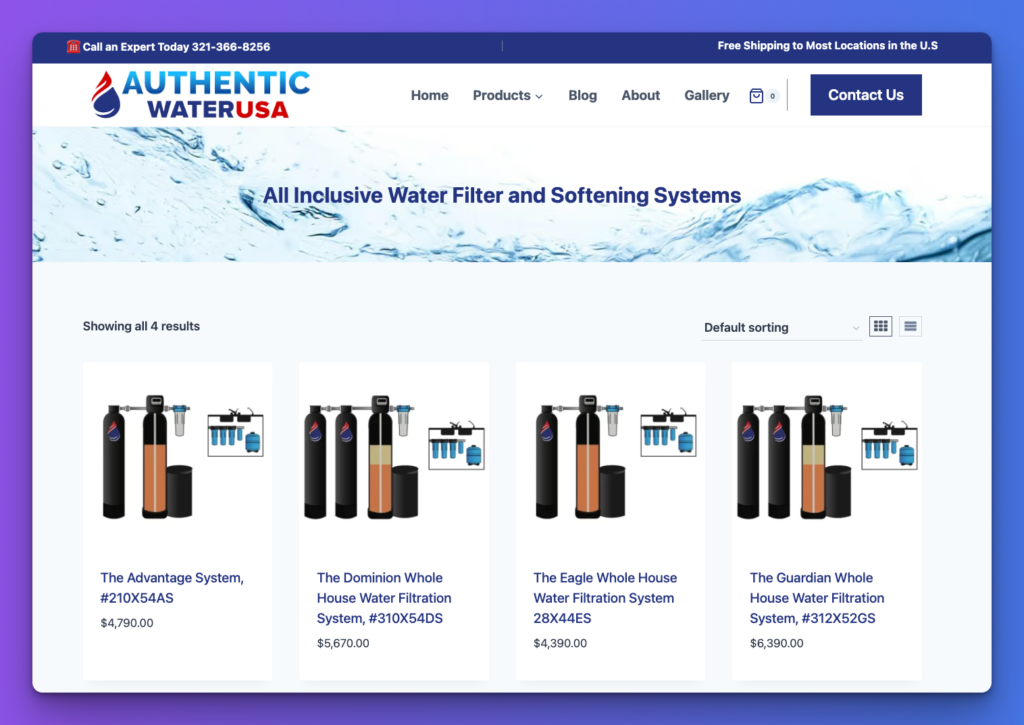
It started innocently enough. A simple conversation at the breakfast table: “Honey, maybe we should look into getting a whole house water filtration system?”
Famous last words.
What should have been a straightforward home improvement decision quickly spiraled into what can only be described as a TED Talk series on water quality, filtration technologies, and why settling for “good enough” is basically admitting defeat in life.
Let me paint you a picture. My husband, bless his practical heart, typed “whole house water filter” into Google, clicked on the first result with decent reviews and a reasonable price tag, and declared, “This one looks fine. $800. Done.” Total research time: 4 minutes.
Meanwhile, I had already opened 47 browser tabs.
The Information Avalanche Begins
You see, I couldn’t just pick “a” water filter. I needed to understand micron ratings, the difference between sediment filters and carbon filters, whether we needed a reverse osmosis system, if UV filtration was overkill or absolutely essential, and whether our municipal water report indicated we should be concerned about chromium-6 levels.
“It’s just water,” he said, as if I had suggested we build a particle accelerator in the basement.
“It’s our HEALTH,” I countered, pulling up a 23-page PDF from the EPA about water contaminants.
I started texting him links. Lots of links. Articles about chlorine byproducts. Studies on lead leaching. Comparison charts between whole house water filtration systems and point-of-use filters. Customer reviews that were basically dissertations. YouTube videos of people installing systems in their homes (some went well, others… did not).
His phone buzzed. And buzzed. And buzzed.
“How many articles are you going to send me?” he asked, eyes glazing over as notification number 14 appeared on his screen.
“As many as it takes for you to understand why we can’t just buy the first filter we see,” I replied, already queuing up link number 15.
The Specifications Showdown
My husband wanted simple: something that removes the bad stuff, doesn’t break the bank, and installs without requiring an engineering degree.
I wanted optimal: a multi-stage filtration system with pre-filters, carbon blocks rated for at least 10,000 gallons, NSF certification for contaminants 42, 53, AND 401, a system that could handle our home’s specific flow rate, and preferably something that wouldn’t require filter changes every three weeks because that’s just not sustainable.
“This $2,400 system has a five-stage filtration process,” I announced triumphantly, showing him my phone screen.
He looked at me like I’d just suggested we vacation on Mars. “That’s three times what we need to spend.”
“But it removes PFAS!”
“What’s PFAS?”
And then came another link. And another article. Something about “forever chemicals” and why they’re in everything and why we should care and why this particular system is actually a bargain when you consider the long-term health implications.
I could see his soul leaving his body.
The Reasonable Middle Ground (That I Almost Rejected)
Here’s the thing that took me three weeks to admit: sometimes “reasonably priced” doesn’t mean “settling.” Sometimes it means finding something that works well, fits our actual needs (not our imagined apocalyptic water contamination scenarios), and doesn’t require me to become a part-time hydro-geologist to maintain.
The EPA provides great information about water quality standards, and most municipal water already meets strict safety requirements. Sometimes “good enough” is actually, well, good enough.
My husband wasn’t being careless—he was being practical. His $800 filter would have done the job. But after drowning him in information, we compromised on a $1,200 system that made us both happy. It removes the contaminants we actually need to worry about, has good reviews, and won’t require us to take out a second mortgage.
The Real Filter We Needed
Looking back, maybe the real filtration system we needed wasn’t for our water—it was for my information overload. Instead of hitting him with every scientific study ever published about water quality, I could have:
- Started with our actual water quality report
- Identified the 2-3 contaminants we actually needed to address
- Compared 3-4 systems instead of 40
- Made a decision in days, not weeks
To all my fellow research enthusiasts out there: your husband probably doesn’t need the 18th article about activated carbon vs. catalytic carbon. He just needs to know it’ll make the water taste better and keep the family safe. The rest is what we like to call “enthusiastic over-preparation.”
And gentlemen, if you’re on the receiving end of the information fire hose: we’re not trying to make you crazy. We’re just trying to make sure we’ve thought of everything. Even if “everything” includes scenarios that have a 0.0001% chance of happening.
In the end, we got our water filtration system installed last month. The water tastes great. My husband is happy. I’m happy (though I still occasionally send him articles about maintenance schedules).
And yes, I have three browser tabs still open about water filtration. Just in case.